Page 23 - Winds Of Change Fall 2018
P. 23
mother is Cherokee,
and when we visit her
family in Kentucky I
get to feel more
connected to my
heritage. It’s also great
to feel that stronger
connection closer to
home.” In fact, when
she goes to college (no
decision yet on where), Quinlan may opt for a minor in Native American studies while pursuing a major in biology — and why not, maybe a second major in computer science.
Quinlan’s summer project this year was investigating the mechanisms of Type 1 diabetes resistance in a particular strain of nonobese diabetic mice. She was selected to conduct that research as part of the presti- gious Summer Student Program at the Jackson Laboratory, a nonpro t biomedical research facility based in Bar Harbor, Maine. “Its mission to promote better health care through genetic research is really opening my mind to all kinds of possibilities for my work moving forward,” she says.
The internship was the latest in a series of honors for Quinlan. That list includes an Intel International Science and Engineering Fair second-place Grand Award, a Rachel Carson Book Award, a Stanford University internship,
multiple NAIVSEF awards dating back to 2016 — and to round things out, a handful of art show awards for street photography. “I love how photos can capture a single moment in time and preserve it forever,” she says.
Quinlan is currently focusing on immune cell populations, exactly how Type 1 diabetes develops, and the impact of certain genes in slowing or preventing the development of the disease in mice. It’s advanced work for anyone, and especially for a 17-year-old. But for Quinlan, it’s part of everything coming together after a lot of work and determination.
After all, this scientist has plans. “I think my dream job would be working as a
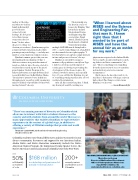
“When I learned about AISES and the Science and Engineering Fair, that was it. I knew right then that I wanted to be part of AISES and have the annual fair as an outlet for my work.”
physician investigator for the Indian Health Service, maybe an endocrinologist research- ing diabetes in Native communities,” she says. “There’s something very compelling about the intersection of access to nutrition and medical care and socioeconomic circumstances.”
But for now, she has other work to do. And there’s that matter of being a senior in high school. One thing is certain: Anna Quinlan is on her way.
— Susan Biemesderfer
CHEROKEE
One of the largest employers
in northeastern Oklahoma, the Cherokee Nation employs more than 11,000 people in enterprises that range from aerospace to entertainment venues.
“There’s an amazing amount of diversity at Columbia which allows me to interact with Native students from across the country and with students from around the world. There are so many opportunities that enable Columbians to explore Native experiences in the context of a global stage, in addition to o ering a variety of STEM internships that provide real world experience.”
MARIAH GLADSTONE, Earth and Environmental Engineering
Blackfeet; Helena, MT
Columbia students come from all  fty states and ninety countries in our diverse community. Resources and support for our American Indian, Alaska Native and Native Hawai’ian community include the Native American Studies Program, the Indigenous Forum Speaker Series, the Native American Council and annual Columbia University Pow Wow.
200+
research centers and facilities across Columbia
Eileen Barroso
over
50%
self-identify as students of color
$168 million
in scholarships and grants awarded annually to undergraduates
aises.org
FALL 2018 • WINDS OF CHANGE 21
FOR MORE INFORMATION, PLEASE CONTACT: Maria Gracia Asayag
Director of Multicultural Recruitment O ice of Undergraduate Admissions mga2138@columbia.edu undergrad.admissions.columbia.edu